
Penguins: The Tuxedoed Travelers of the Southern Seas Birds That Swapped the Sky for the Sea
Penguins are flightless seabirds that have traded the air for the ocean. Their wings have evolved into stiff, powerful flippers, and their dense, waterproof feathers and streamlined bodies make them superb swimmers. Some species can reach speeds of around 15 to 20 kilometers per hour underwater, and the emperor penguin can dive deeper than 500 meters.
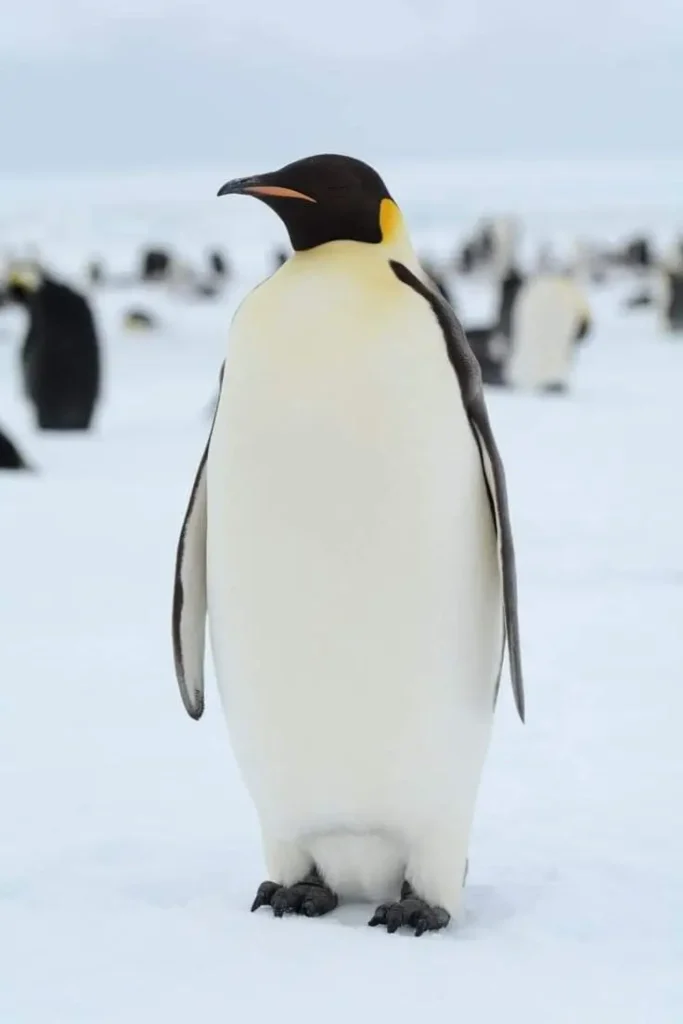
Their famous black-and-white coloring is practical camouflage. From above, a dark back blends with the dark water. From below, a white belly blends with the bright surface, hiding penguins from both predators and prey.
A Brief History: Ancient Swimmers
Penguins have a surprisingly long history. Fossil evidence shows that penguin ancestors were already swimming in the oceans around 60 million years ago, not long after the dinosaurs disappeared. Some prehistoric penguins were giants. Fossils from New Zealand and Peru have revealed species that stood well over a meter tall, far larger than any penguin alive today.
Over millions of years, penguins spread across the Southern Hemisphere, adapting to environments ranging from icy Antarctic coasts to warm tropical islands.
Discovery and Naming
Indigenous peoples of the Southern Hemisphere knew penguins long before Europeans arrived. Europeans first encountered them during the great age of sea exploration. Sailors in the late 15th and 16th centuries, including those on Vasco da Gama’s voyage around Africa and later Ferdinand Magellan’s expedition, recorded sightings of strange flightless birds along southern coasts.
The origin of the word “penguin” is still debated. One theory links it to the Welsh words pen gwyn, meaning “white head,” originally used for the now-extinct great auk of the North Atlantic. Sailors later applied the name to the similar-looking birds they found in the south, even though the two are not closely related.
Where Are Penguins Found?
A common myth is that all penguins live in the freezing Antarctic. In reality, penguins live almost entirely in the Southern Hemisphere, across a wide range of climates:
- Antarctica: home to emperor and Adélie penguins, which endure some of the harshest conditions on Earth.
- Sub-Antarctic islands: king, macaroni and rockhopper penguins nest on islands like South Georgia and the Falklands.
- South Africa and Namibia: the African penguin, sometimes called the “jackass penguin” for its donkey-like bray, lives on rocky shores and beaches, including the famous colony at Boulders Beach near Cape Town.
- South America: Magellanic and Humboldt penguins live along the coasts of Chile, Argentina and Peru.
- Australia and New Zealand: little penguins, the smallest species, and the rare yellow-eyed penguin.
- The Galápagos Islands: the Galápagos penguin, the only species that lives right on the equator and the northernmost of all penguins.
Meet the Species
There are around 18 recognized species. The emperor is the tallest, standing about 1.1 meters. The little penguin is the smallest, at roughly 30 centimeters. Others include the Adélie, chinstrap, gentoo, king, rockhopper and macaroni penguins, each with distinct markings, from the bright orange head plumes of the macaroni to the thin black line under the chinstrap’s chin.
Family Life and Survival
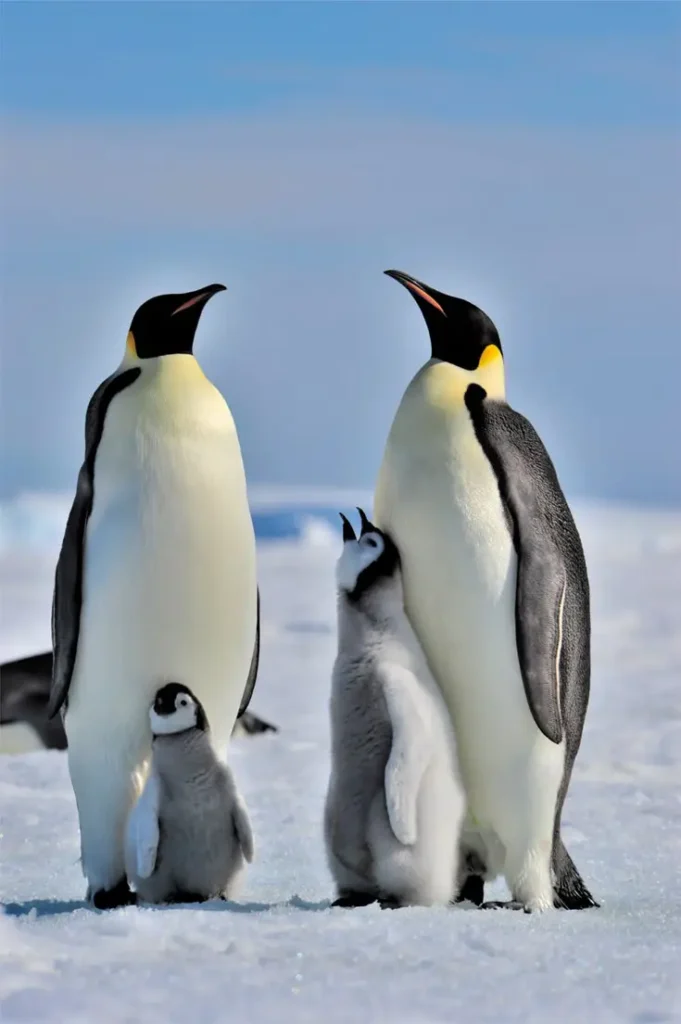
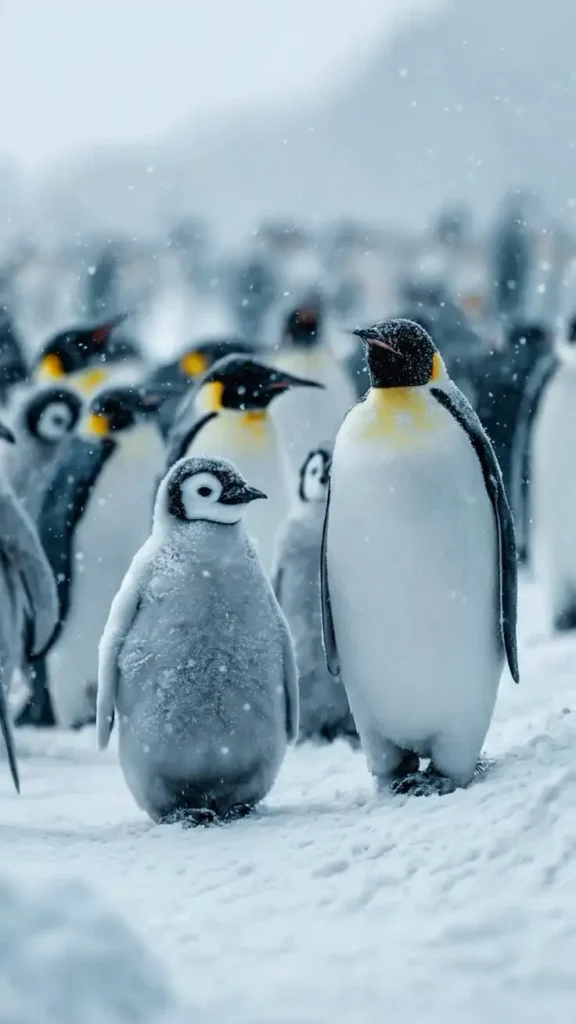
Penguins are known for their devoted parenting. Emperor penguins endure the Antarctic winter to breed. After the female lays a single egg, the male balances it on his feet under a warm fold of skin for about two months, fasting through blizzards while the female goes to sea to feed. Penguins also huddle together in tight groups, rotating positions so each bird gets a turn in the warmer center.
Many species are social and nest in huge colonies, sometimes numbering in the hundreds of thousands. Several species form long-term pair bonds, and some are known to return to the same mate and nest year after year.
Threats and Conservation
Many penguin species are in trouble. Climate change is shrinking sea ice and shifting the fish and krill they depend on. Overfishing, oil spills, pollution and habitat disturbance add to the pressure. The African penguin is now classed as endangered, with populations falling sharply over the past century, and several other species are listed as vulnerable or endangered.
Protected marine areas, fishing limits, nesting-site protection and ongoing scientific monitoring are all helping, but penguins remain sensitive indicators of ocean health. When they struggle, it signals problems in the wider marine ecosystem.
Final Thoughts
Penguins combine ancient history, remarkable adaptations and endearing personalities. They are a reminder of how life can thrive in extreme places, and how fragile that balance can be. Learning about them, supporting conservation efforts and reducing our environmental footprint all help ensure these charming birds keep waddling, sliding and swimming for generations to come.