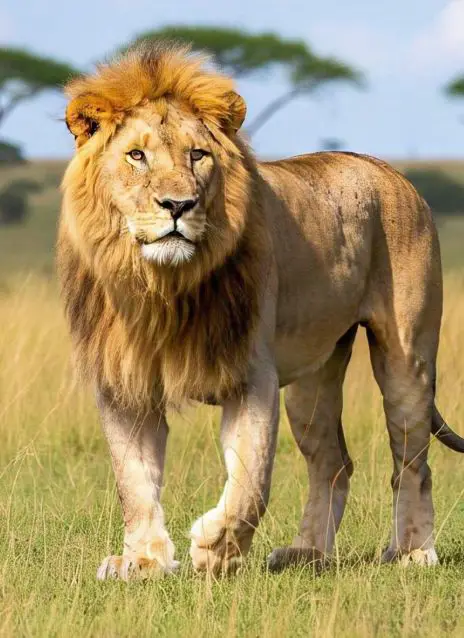
Lions: The Kings of the Savanna
The Social Cat
The lion (Panthera leo) is the only truly social big cat. While tigers, leopards and jaguars mostly live and hunt alone, lions live in family groups called prides. A pride usually includes several related females, their cubs, and a small group of adult males. Adult males can weigh up to 190 kilograms, while females are lighter and do most of the hunting.
The male’s mane is its signature feature. Darker, fuller manes often signal good health and strength, and may help males appear more intimidating to rivals and attractive to females.
A Brief History: Ancient Roamers
Lions have an ancient lineage. Fossil evidence suggests that the ancestors of modern lions emerged in Africa roughly a million years ago, and from there they spread widely. Cave lions, a larger relative, once ranged across Europe and into northern Asia, and prehistoric artists left striking images of them on cave walls in France, such as at Chauvet.
At their height, lions were among the most widespread large land mammals, living across Africa, southeastern Europe, the Middle East and parts of India. Lions survived in Greece into the Roman era, and the Asiatic lion once prowled from Turkey to eastern India.
Discovery and Human Culture
Like tigers, lions were never “discovered” in the scientific sense. Africans and Asians lived alongside them for millennia. Lions appear in ancient Egyptian art and in Mesopotamian carvings, where kings were shown hunting them as a symbol of power. The Egyptian goddess Sekhmet had a lioness’s head, and lions became symbols of royalty, courage and strength across many cultures, from the Lion of Judah to the heraldry of medieval Europe.
Scientifically, the lion was formally described by Carl Linnaeus in 1758 as Felis leo, later reclassified as Panthera leo. In the 19th century, European explorers and hunters spread accounts of African lions, which fueled both fascination and heavy hunting.
Where Are Lions Found Today?
Lions now occupy only a small portion of their historic range:
- Sub-Saharan Africa: the stronghold of the species, with major populations in Kenya, Tanzania, Botswana, South Africa, Zambia and Zimbabwe. Famous parks include the Maasai Mara, Serengeti, Kruger and Etosha.
- Kenya: home to iconic populations in the Maasai Mara, Amboseli, Tsavo and Nairobi National Park, which is remarkable for being a wild lion habitat right beside a capital city.
- West and Central Africa: small, fragmented and often critically threatened populations.
- Gir Forest, India: the last home of the Asiatic lion, a distinct population found only in Gujarat.
Lions prefer grasslands, savannas and open woodlands, where they have room to hunt herds of zebra, wildebeest, buffalo and antelope.
Life in the Pride
Lionesses typically work together to hunt, using teamwork to stalk and ambush prey. Males defend the pride’s territory and protect it from rival males. Lions spend a surprising amount of time resting, often 16 to 20 hours a day, saving energy for the hunt.
Cubs are born in hidden dens and are cared for by the whole pride. Sadly, many do not survive their first years, falling victim to hunger, predators or rival males taking over a pride.
A lion’s roar can be heard up to about 8 kilometers away, helping the pride communicate and mark territory.
Subspecies and Populations
Lions are broadly grouped into African lions and the Asiatic lion, with scientists still debating how many distinct subspecies exist. Some populations, such as the Barbary lion of North Africa and the Cape lion of South Africa, have disappeared in the wild.
Threats and Conservation
Lion numbers have dropped dramatically. Estimates suggest around 20,000 to 25,000 wild lions remain today, down from far larger populations in the past. They are listed as vulnerable. The main threats include:
- Habitat loss as farmland and settlements expand
- Human-wildlife conflict, when lions attack livestock and are killed in retaliation
- Loss of prey due to bushmeat poaching
- Illegal killing and trade in lion body parts
Community conservancies, especially in Kenya, have shown that when local people benefit from wildlife through tourism and conservation jobs, lions have a better chance of survival. Tools like predator-proof livestock enclosures and lion monitoring programs are also helping reduce conflict.
Why Lions Matter
As apex predators, lions keep herbivore populations in check, which protects grasslands and the countless species that depend on them. They also drive tourism that supports local economies and conservation efforts.
Final Thoughts
The lion’s story spans prehistoric caves, ancient thrones and modern savannas. It is a symbol of strength, but it is also a species that needs human help to endure. Supporting responsible tourism, community-led conservation and wildlife protection are practical ways to make sure the lion’s roar keeps echoing across the plains.